


This is the inaugural issue of The Kyiv Valley.
We’re writing it because the people building companies in Ukraine deserve to be covered properly, and because we find the story of what they’re doing interesting, and sometimes moving. We’ll bring you news, milestones, and the occasional longer piece, and we hope this becomes a place where anyone who cares about Ukrainian tech, anywhere in the world, checks in. It’s a passion project for all of us working on it.
Ukrainian tech and culture move faster than any four people can follow, so we’ll need your help. If you’re launching, raising, hiring, or shipping something we should know about, write to us at news@thekyivvalley.com. We’re working on some merch for the best tips.
If you know anyone who should be paying attention to Ukrainian tech but isn’t yet, forward this to them.
Thanks for reading. Now let’s get started.
Jim, Daria, Mark and Yulia
Kyiv, Ukraine
The Ukrainian Play on AI
By Jim Curry
Ukraine has more YC-backed companies than any other country in Central and Eastern Europe: 37 for Ukraine, 34 for Poland, and then everyone else, according to new research from SMOK Ventures.
I’ve known Ukraine was a tech center since I first hired developers here, years ago. Still, it was good to see it in a table.
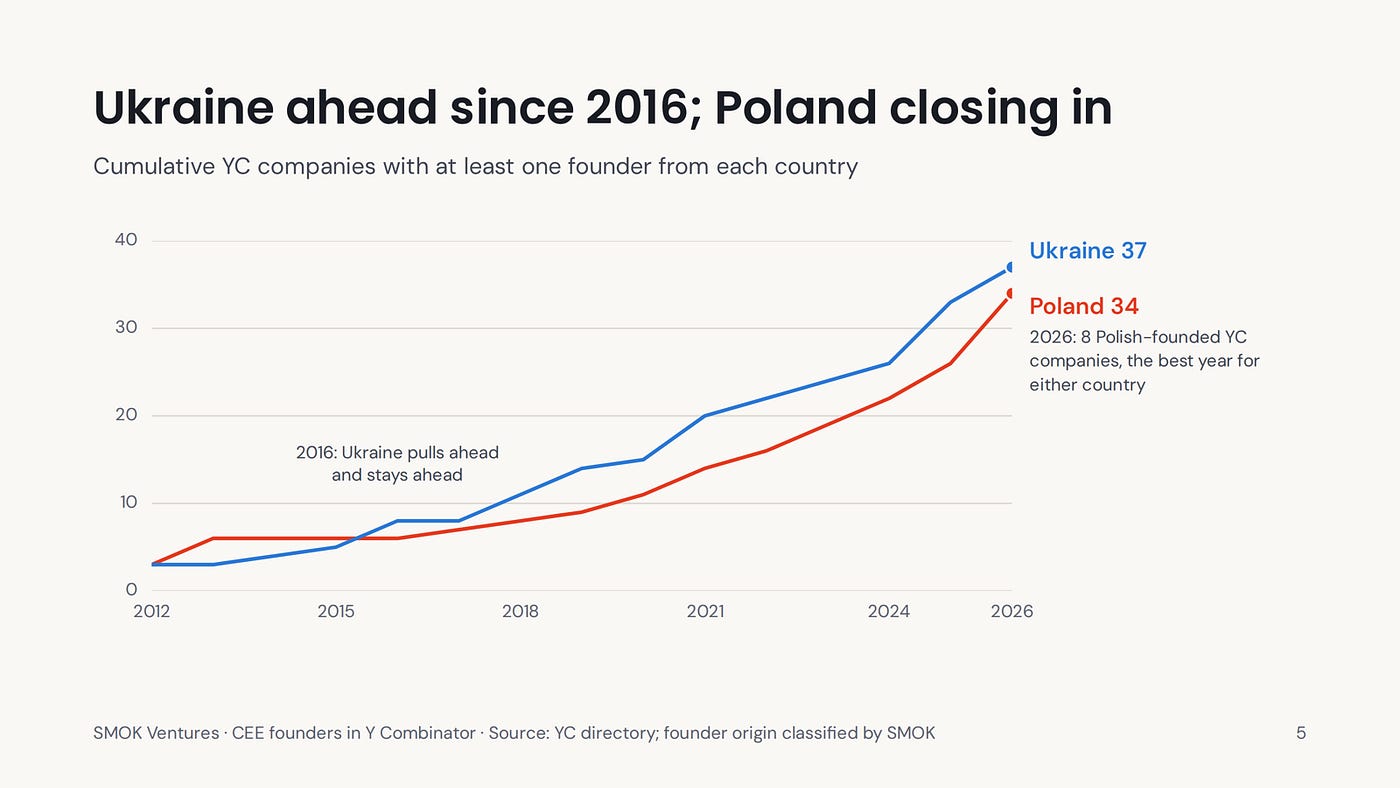
But now it’s all about AI, for better or worse. So what is happening here in Ukraine?
Over the last few months, a whole wave of companies I follow have either launched agentic products or pivoted the whole business toward them.
Ukraine doesn’t have a foundational model company, and probably won’t. What it has instead are founders who spent years inside one industry and are now rebuilding what they know around AI. They are using the data and distribution they have created to fundamentally recreate their offerings with AI. Some of these products could change their categories.
This issue covers four of them: finance, logistics, real estate, and sales. Each one shipped or was previewed in the past couple of months.
Fuelfinance turned seven years of closing books into agents
Alyona Mysko has rebuilt Fuelfinance, until recently an FP&A platform with a CFO-as-a-service option, as a platform of finance agents.
While she was building it, Alyona talked to 30 finance teams, and three of them were using agents. That’s how early the market is.
Before the pivot, her team closed the books for hundreds of companies by hand, around $4 billion of P&L in total. That is what the agents learned from. Before an agent goes live for a customer, it is run on a customer’s own historical data, so its output can be checked against books already closed by humans. And even in production, no items are recorded on the ledger without a person approving them.
The customers are not small. Lasko Products, the number-one fan and heater company in the US and in business since 1906, used to spend five or six hours a day reconciling cash across 23,000 transactions. It now takes under ten minutes. Its monthly closing deck, which took two days and ran to 150 pages, is now produced on demand.
Cargofy wants to onboard logistics customers without sending an engineer
Cargofy has been running AI agents in freight for two years. It just shipped Cargofy 2.0, which includes Architect, an agent that onboards a new customer on its own. Cargofy says no one else in freight AI has shipped one.
AI doesn’t work out of the box in an industry like logistics. Every customer runs differently, so the market has scaled on forward-deployed engineers: someone from the vendor sits on-site for weeks and builds a custom setup. That is slow and expensive, and it caps how fast anyone can grow.
Architect replaces that labor-intensive process. It reads up on the company from public sources, interviews the leadership about what’s broken, and builds the setup around how they already work. In principle, a shipper the size of Coca-Cola, with dozens of stakeholders, could rebuild its freight operation on Cargofy without an engineer in the building.
Stakh Vozniak, the founder and CEO, wrote on LinkedIn that the team spent two years on this effort with one aim: shrink the gap between signing a customer and delivering value, whatever the customer’s size. That matters because in logistics, customer onboarding is the business. Whoever can take on a new shipper in days instead of months, without adding headcount, gets to compound growth while everyone else is hiring engineers. Competitors like HappyRobot are still scaling on FDEs, and if Architect does what Cargofy says it does, that is a lead that is hard to close.
Jome stops selling homes and starts selling the sales team
Jome hasn’t done its big public launch yet, but Sofia Vyshnevska, co-founder and now CEO, led the shift and is previewing it for the market.
Sofia and her co-founder Dan Hnatkovskyy started the company in Ukraine, went through Techstars Austin, and launched the marketplace in September 2020, in the middle of COVID. For five years, Jome ran a marketplace for new-construction homes: it pulled builders’ listings into one searchable place, its own agents walked buyers through the purchase, and the builder paid a commission when the home closed. That business grew to more than $7 million a year in revenue through the war, with much of the team working from Ukraine (the founders are in Austin). Then rates spiked, and buyers disappeared.
Through 2025, the team was using AI inside its own sales operation and realized the tool was worth more than the marketplace. In January 2026, they pivoted: they took what they knew about selling new homes and sold it to the builders directly. The agents are trained on each builder’s inventory, financing options, and sales process, and then do the work of a sales team: they contact buyers by phone, text, and email, answer their questions, follow up with leads that went quiet, and book visits to the model home.
The arithmetic is simple. Sofia has cited a builder with 65,000 leads sitting in its database, and reaching one person on that list takes about eight attempts. No sales team is going to make 520,000 attempts. An agent will.
Since the pivot, they’ve been growing with their first customers, and big product updates are planned for November.
AiSDR takes the human out of the loop and cuts the price by two-thirds
I met Yuriy Zaremba at their office in Lviv this summer. He and his brother Oleg had already built and sold one company, AXDRAFT, a legal-tech startup that Onit bought in 2020, before they started AiSDR.
For two years, AiSDR sold an AI sales rep with a human watching over it. In September, they shipped Ami, which runs on its own, and cut the price from $900 a month, demo required, to $250 self-serve.
Give Ami your website, and it figures out who your customers are, decides what signals to watch for, writes the campaign, and runs it across email and LinkedIn, killing what doesn’t work and doing more of what does work. It learned from three years of AiSDR’s own history: 2.5 million emails, 17,000 campaigns, 20,000 booked meetings, and 1,200 customers in 27 industries. Yuriy says it generated $697 million of pipeline for customers in three months of beta.
The interesting choice is staying downmarket. Yuriy’s view is that the first wave of AI SDR tools automated the mechanics of outbound (finding leads, writing emails, sending and replying), but most of the small companies buying them had never defined who their customer was or what they were offering. The tools did exactly what they were told, which meant sending more bad emails to the wrong people, faster. Most of his competitors reacted by moving upmarket to enterprises, which already have a defined customer, a defined offer, and a sales team to run the tool. Yuriy stayed with small companies instead and put the strategy inside the agent, so a small company gets the same answers a $100,000 consultant would give it. Replit and Lovable made it easy to start a software company; Ami, as he puts it, is meant to make it just as easy to find customers for one.
Why this matters
What strikes me about these four is how much of the work was done before anyone said the word “agent.” Alyona closed books for seven years. Cargofy ran freight ops for two years before it tried to automate the onboarding. Jome spent five years learning how builders sell homes. The Zaremba brothers had already built and sold a sales-heavy company before they tried to replace the SDR. In each case, the AI is the last layer on a business that already understood its customer in detail, and that is why the products work on day one rather than in a demo.
That is also, I think, the shape of the opportunity in Ukraine. The country is not going to produce the next frontier model, and it doesn’t need to. It has a deep bench of founders who know one industry cold, who are used to building with less, and who are now moving faster than the better-funded teams in their categories that are still learning the domain. The YC numbers at the top of this piece are one way to see that. The four companies above are another, and I expect we’ll be writing about more of them in the coming issues.

More news from The Kyiv Valley
Here’s the top news from Ukrainian tech over the last two weeks. You’ll get one of these every other week.
Funding & deals
Same pattern as the essay: founders who know their industry, building the software for it.
PixelCrew raised a round from u.ventures. It’s the new startup from Dmitriy Zaporozhets, who co-founded GitLab, and Andriy Dyadyura (ex-Apple, GitLab). Its AI agents act as a design team, turning a text prompt into design and code. (dev.ua)
Promova, a language-learning app, is returning to Boosters, the Ukrainian app studio where it was built in 2019. CEO Andriy Skrypnyk is leaving. (dev.ua)
Launches
Almost everything shipped this fortnight has an agent doing the work.
OBRIY.ai, a Kyiv AI startup founded this year, launched SURE, a team of AI agents that answers customer support requests. It already handles 50,000+ requests a month. It also won Best Ukrainian-Founded Startup at UATECH Venture Night in San Francisco, held during TechCrunch Disrupt.
MacPaw, the Kyiv company behind CleanMyMac, one of the most popular Mac apps, took its AI assistant Eney out of preview on Mac and iPhone. Eney connects to Gmail, Slack, Notion and other tools and runs tasks on its own, from $14.99 a month. (MacPaw)
Respeecher, the Kyiv voice-AI company, and Sigma Software, a Ukrainian-Swedish engineering firm, launched a Swedish text-to-speech model for regulated industries and the public sector. It can run on the customer’s own servers or on an EU-only cloud, which is what regulated buyers in Europe increasingly ask for. (Sigma Software)
Toloka VC, a Ukrainian angel syndicate with more than 1,300 investors, built an AI tool that tracks 3,500+ startups a month to spot early deals. It plans to open the tool to other investors by the end of the year. (Forbes Ukraine)
People
Talent from Ukraine’s digital government is moving into business, and Ukrainian-founded companies are hiring senior US leaders.
Oleksandr Savchenko, former CTO of the Ministry of Digital Transformation (the team behind Diia, Ukraine’s government-in-an-app), joined NovaPay as Chief Digital Transformation Officer. NovaPay is the fintech arm of Nova Group, whose Nova Poshta is Ukraine’s largest delivery company. (Forbes Ukraine)
Preply, the Ukrainian-founded online tutoring marketplace, hired Lillian Rizkallah Reaume, formerly Chief People Officer at Stitch Fix and Rubrik, as Chief People Officer, and Bilal Zia as VP of Data Science & Analytics. (PR Newswire)
Digital government
The part that surprises people outside Ukraine most: the state runs on apps, and it keeps building and shipping them.
Mriya, the government’s app for schools (timetables, grades and learning materials in one place), rolled out an AI tool that writes tests for teachers to 500 schools. (Government of Ukraine)
Coming up
Slush, Helsinki, 18–19 Nov. It’s one of Europe’s biggest startup conferences, and the Ukrainian Startup Fund, a state-backed grant program, is bringing 12 Ukrainian startups. (Speka)
Forbes Tech, Kyiv, 26 Nov. Forbes Ukraine’s annual tech conference, this year on how AI is changing Ukrainian IT. (Forbes Ukraine)
And one more piece of news, a personal one for us
Vatra Group officially launched in Kyiv with a founders’ dinner.
We brought together some of the people building Ukraine’s next wave of tech companies, with good food and honest conversation about what they’re working on. It was a reminder of why we’re doing this: the talent here is real, and it deserves capital that shows up early and stays for the long run. We’re excited to back founders building from Ukraine.
Know something we should be writing about?
Write to us at news@thekyivvalley.com.
The Kyiv Valley Team
Great first issue straight out of the gate! Looking forward to following this scene!
Your line that the AI is «the last layer on a business that already understood its customer» applies well beyond startups. We see the same pattern in Ukraine's municipal infrastructure: the projects that attract capital are the ones where the city has already done years of unglamorous groundwork. Great to see a newsletter making Ukrainian builders visible to investors, and welcome to Substack!