

By Jim Curry
Signal lost
This issue is about space, not the war. But in Ukraine right now, the two are hard to separate, and Starlink is a big part of why. Here’s a quick recap.
In mid-October, Ukrainian drones started losing their satellite connection mid-flight. Anything moving faster than about 160 km/h (100 mph) dropped off both Starlink and Starshield, the military version that runs on the same satellites. According to Zelensky’s adviser on defense tech, nobody on the Ukrainian side had been warned. Missions failed, and for ten days the front line worked around it. On October 24th, speeds were restored. The same day, Elon Musk said on X that SpaceX had throttled Starlink because Ukraine had used it for offensive drone strikes, and that Starshield, which the Pentagon pays for, is controlled by the US government. Washington says it gave no order.
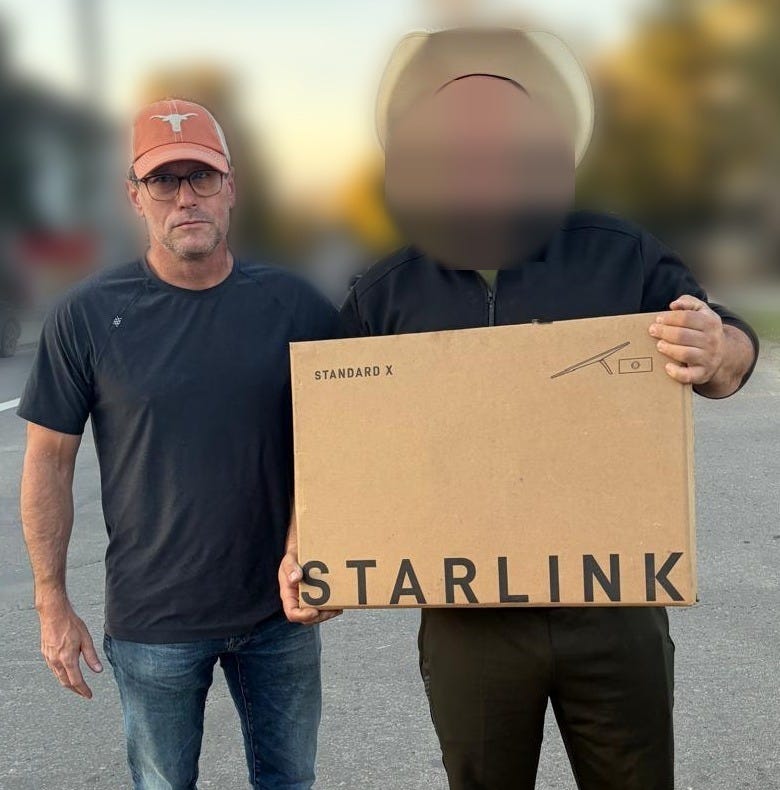
Ironically, yours truly was delivering Starlink units to a military unit in eastern Ukraine in October at about the same time. As an American, I found the timing very unpleasant, and once again I found myself trying to explain… well, the unexplainable. But they did appreciate the cowboy hats!
Since around November 11, it has happened again, this time to Starshield alone, capped at the same speed over the front line and occupied territory. That matters more than it sounds. Starshield is what Ukraine uses for its faster drones, including the interceptors it sends against jet-powered attack drones, and those interceptors lose their link exactly when they need it.
The lesson is clear, and it’s the same one Europe has been learning all year: if you don’t control your own connection to space, someone else does.
And it’s not only Ukraine and Europe thinking about this. Y Combinator’s latest list of startup requests, the same one that asked for robots made in America, includes startups for a world of abundant space access. Launches keep getting cheaper. The bigger question is who controls what’s up there. Ukraine, more than anyone else, understands how important this question is.
Starlink switched on in Ukraine two days after it was requested in February 2022, and more than 50,000 terminals have been delivered since. Poland has paid for roughly half the network. That contract runs out at the end of December, and nothing has been signed for next year. Ukraine’s Starshield agreement with the US government expires in mid-2027.
What makes this more than a dependency story is that Ukraine, of all countries, knows how to do space.
Rocket City
For decades, Dnipro was one of the most important places in the world for building rockets.
I know this from personal experience. My father was a NASA engineer for most of his career, and there was a lot of talk at the dinner table about the great USSR-USA space rivalry.
He always admired the work of Soviet engineers, but it was not until I became an adult that I realized he was really talking about Ukrainian engineers.

Dnipro’s design bureau and factory, now Pivdenne and Pivdenmash, started in the 1950s, and at the factory’s peak more than 60,000 people worked there. After independence, Dnipro built rockets for commercial customers, and until 2023 it built the first stage of Northrop Grumman’s Antares rocket, which flew cargo to the International Space Station.
Today it’s a different picture. Ukraine cut its space ties with Russia after 2014, and most Western launch contracts ended after 2022. Dnipro is now close enough to the front that missiles and drones hit it regularly. In November 2024, Pivdenmash itself was the target of Russia’s first strike with its new Oreshnik ballistic missile.
Generations of Ukrainian engineers learned to design engines, guidance systems and spacecraft there, and that know-how is now showing up in a new generation of companies.
Ukraine’s new space generation
Ukraine’s space industry today looks very different from the one Dnipro built. It’s a mix of startups and fast-growing defense companies, some at home and some abroad, building the pieces a country needs to have its own space layer: satellites, the terminals that talk to them, the technology to service them in orbit and the rockets to get them there. Here are the ones to know.
Stetman builds satellite terminals. In April it set up a joint venture with Denmark’s GomSpace, called UASAT, to build a secure satellite network for Ukraine’s government and military. Production starts in Denmark and is meant to move to Ukraine. The target is 120 satellites by 2027 and around 360 by 2030, with a total cost of over 1 billion euros.
HIMERA makes secure military radios that keep working under electronic warfare. On October 1, OBRIA NANO, a test satellite for Ukraine’s own secure communications network, reached orbit on a SpaceX rocket. GomSpace built it, the same Danish partner Stetman works with. HIMERA says full coverage needs around 100 satellites, hundreds of millions of euros and at least two to three years. It’s a small demonstrator, but it’s the first step. HIMERA’s CEO, Misha Rudominski, also co-founded Promin Aerospace (below).
Kurs Orbital takes its name from Kurs, the system built at Kyiv’s Radio Factory that lets spacecraft dock with space stations automatically. Led by the former head of Ukraine’s space agency, the company now builds a module that lets satellites meet and dock in orbit, so they can be serviced, refueled or moved. It’s based in Turin, with R&D in Kyiv, and raised $4 million from investors including In-Q-Tel, the CIA’s venture arm.
Promin Aerospace, started in Dnipro, is working on one of the most unusual rockets out there: one that burns its own body as fuel, so there’s less dead weight to lift. The goal is the smallest rocket that can reach orbit, for launching tiny satellites.
And then there’s the European side. On October 22, Ukraine’s Ministry of Defense signed a letter of intent with Finland’s ICEYE and Nokia to explore a sovereign satellite network for the military. ICEYE has its own Ukrainian story: in 2022, a Ukrainian charity foundation crowdfunded access to one of its radar satellites, which the army used to spot thousands of military targets through cloud and at night. This summer, ICEYE raised €450 million at a valuation above €10 billion.
Why this matters
To be honest, this is a start, not a comeback yet. One test satellite and a letter of intent won’t replace 50,000 Starlink terminals. Ukraine’s own network is a plan for the next few years. But given the unbelievable pace of innovation Ukraine has demonstrated in the miltech sector, I have no doubt that these timelines will be met, if not substantially beaten.
The timing is also right. Europe is spending heavily on space it controls. European space startups raised $3.8 billion in the first nine months of this year, against $1.4 billion in all of 2025, according to Dealroom.
Ukraine has the engineers, the history and the most urgent reason of any country to build its own network.
This is going to be an incredibly exciting space to watch (no pun intended).
More news from The Kyiv Valley
Here’s what happened in Ukrainian tech over the last two weeks.
Funding & deals
Defense tech is where the biggest money is moving, and it’s starting to consolidate.
UFORCE, the Ukrainian-founded maker of Magura sea drones, raised a record $700M Series A at a $6B valuation, the largest round ever for a Ukrainian company. It’s also giving stock options to every employee, in the hope that some will use their gains to start companies of their own. (dev.ua)
Swarmer, the Nasdaq-listed drone-swarm software company, is buying ground-robot maker Ratel in a deal worth up to $224M, one of the biggest defense-tech acquisitions in Ukraine. It also closed its deal for part of drone maker Vataga, bringing over its CEO and 14 engineers. (Forbes Ukraine, AIN.UA)
Elomia Health, a Ukrainian mental-health AI startup, acquired Earkick, a US AI companion app with 250,000 users. (dev.ua)
Valkyrie Dynamics, a Kyiv startup building a tiny radar that lets cheap drones intercept other drones in any weather, raised a €1M pre-seed led by Paris-based Hexa. (The Recursive)
Horizon Capital reached €200M at the second close of its Catalyst Fund, two-thirds of its €300M target, backed by EBRD, IFC and other development lenders, with private investors providing about half of the new money. It invests mainly in energy and digital infrastructure. (Kyiv Independent)
NOVA Group, Nova Poshta’s parent, got central bank approval to buy a major stake in BTA Bank, so NovaPay can add deposits, currency accounts and cross-border payments. (AIN.UA)
u.ventures, a Ukrainian-rooted VC fund, has grown to $60M, and more than 90% of its recent investments are in AI. (Forbes Ukraine)
Launches
From Hollywood-grade voice AI to drones that carry the wounded out, plus a startup that now runs on as many agents as people.
Respeecher helped CD Projekt Red bring back Jacek Rozenek, the Polish voice of Geralt, whose voice changed after a stroke, for the new Witcher 3 expansion. (dev.ua)
Skyfall is scaling Stargate, a drone that carries wounded soldiers out of the front line at 105 km/h, and aims to make 1,000 a month by the end of the year. (Kyiv Post)
Oko Kamera, a Ukrainian thermal-camera maker, is opening production and an R&D centre in the Netherlands, aiming for 100,000 cameras a year by 2027. (AIN.UA)
Alta Ares, a French-Ukrainian company, won 6 of 16 lots in a NATO tender for counter-drone systems. (Forbes Ukraine)
Uklon, Ukraine’s ride-hailing app, launched in Albania, its second foreign market after Uzbekistan. It also reported $33.5M in Q3 revenue and its first acquisition. (Mind.ua)
People
Mykhailo Fedorov, former Minister of Defense and Digital Transformation, co-founded Mission Defense Partners with Lasar’s Group founder Pavlo Yelizarov. It will invest in Ukrainian defense startups and bring in foreign technology. (dev.ua)
Olga Berezhna, a former Vodafone and Veon executive, was appointed Deputy Minister of Digital Transformation, in charge of digital education and skills. (dev.ua)
Yaroslav Azhnyuk, founder of Petcube and The Fourth Law, announced Project Foundation, a semiconductor venture he says will need hundreds of millions of dollars. (LinkedIn)
Digital government
AI is going into schools and into the state’s own data.
Diia.Osvita, the state education platform, launched an AI mentor for computer science lessons in more than 5,000 schools. (dev.ua)
The government ordered a national database of Ukrainian-language texts to train AI models, and is recruiting volunteers to help train Siaivo, a Ukrainian language model. (LIGA.net, dev.ua)
Ukraine is writing its first AI law, closely copying the one the EU passed in 2024. An early draft, published by Ukraine’s IT industry association, would ban some uses of AI outright, add extra checks for riskier uses like hiring or medical tools, and fine companies up to 7% of their revenue for breaking the rules. For Ukrainian AI startups, matching Europe’s rules means they won’t have to comply with two different sets of laws. (IT Ukraine Association)
The IMF wants Ukraine to tighten a tax break that much of its tech industry runs on. Most IT workers aren’t on payroll. They register as self-employed contractors, known as FOPs, and pay a small flat tax on what they earn, far less than employees pay. About half of IT workers work this way. The IMF wants to stop people who are employees in all but name from using it, which could raise costs for Ukrainian tech companies and the people who work for them. (dev.ua)
Coming up
Forbes Tech, Kyiv, Nov. 26, on how AI is reshaping IT outsourcing. (Forbes Ukraine)
clust.team Co-Founders Program, a free 10-week bootcamp for aspiring founders. Applications close Nov. 30. (LinkedIn)